Evidence note: The test, divine interruption, preservation of Isaac, and provision of the ram are explicit. Connections to Christ are canonical typology. Applications to institutional authority are reasoned ethical inferences and are labeled accordingly. Explore the historical and cultural context.
What Watch Tower teaches
Official Watch Tower retellings describe Genesis 22 as a test of Abraham's faith and identify the ram as the sacrifice offered in Isaac's place. This study agrees that substitution is present, while carefully distinguishing what Genesis states from later Christian typology.
Begin with the whole passage
Read: Genesis 22:1–19 ; Leviticus 18:21 ; Deuteronomy 12:29–31 ; 2 Kings 16:1–4 ; Hebrews 11:17–19 ; James 2:20–24
Genesis identifies the event as a test. Abraham obeys while confessing that God will provide. The messenger of Yahweh stops him before Isaac is harmed, reaffirms that the test has demonstrated Abraham's fear of God, and directs attention to a ram. Abraham names the place Yahweh Will Provide. Later Scripture repeatedly condemns the actual burning or giving of children as an abomination.
- verse within paragraph
- paragraph within chapter
- chapter within book
- book within the whole of Scripture
Ask the Holy Spirit, who inspired the written Word and is the Spirit of Truth, to illumine what He gave. Illumination receives the text faithfully; it does not bypass its grammar, context, or place in the whole counsel of God.
The movement of Genesis 22 is promise, test, interruption, and provision.
The narrative does not end with a child consumed by religious obedience. God preserves the promised son and supplies the offering.
Through Isaac
God has already named Isaac as the covenant heir.
Genesis 17:15–21 ; 21:12The promise appears endangered
Abraham is commanded to surrender the son he loves.
Genesis 22:1–6God will provide
Abraham trusts the Promise-Giver beyond what he can see.
Genesis 22:5–8 ; Hebrews 11:17–19Do not harm the boy
Yahweh stops the act before Isaac is killed.
Genesis 22:9–12The ram in his place
God supplies the offering and the son lives.
Genesis 22:13–19Read in context: Genesis 22:1–19 ; Deuteronomy 12:29–31 ; Hebrews 11:17–19 ; James 2:20–24
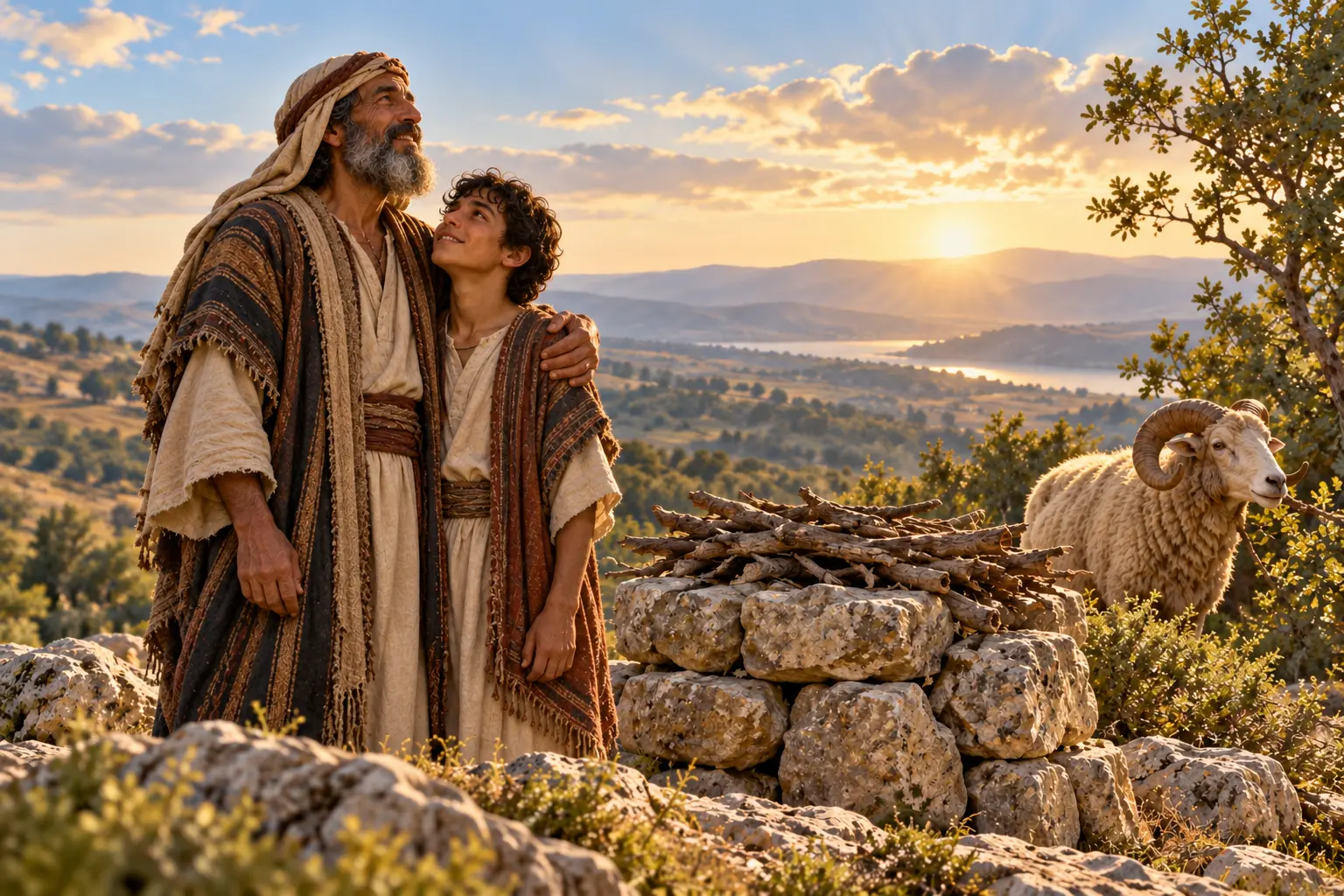
Hear the passage in its first world
Language, customs, institutions, geography, and the beliefs of the ancient world can help us notice what the first hearers likely understood. Background serves the passage. It may clarify the text, but it may not override the wording or manufacture a meaning the passage does not support.
Genesis binds the test to the endangered covenant promise
Isaac is not merely Abraham's beloved son. God has already named him as the child through whom the covenant line will continue. The command therefore appears to place God's own promise in jeopardy, which helps explain Hebrews' emphasis on resurrection reasoning.
Why this matters: The narrative tests whether Abraham trusts the Promise-Giver when he cannot see how the promise can survive.
- Genesis 17:15–21 ; 21:1–12 ; 22:1–19 Promise, named heir, test, and provision
- Hebrews 11:17–19 The New Testament's explicit interpretation of Abraham's reasoning
Child sacrifice was known in Israel's wider ancient world and is condemned in Scripture
Biblical law and prophecy repeatedly address the offering of children, which shows that the practice was a real cultural pressure rather than an abstract possibility. Archaeological and textual debates continue over particular sites and deities, so no single reconstruction should control Genesis 22.
Why this matters: The background makes the divine interruption morally and theologically significant while Scripture's own condemnations remain the governing evidence.
- Leviticus 18:21 ; Deuteronomy 12:29–31 ; 2 Kings 16:1–4 ; Jeremiah 7:21–34 Biblical condemnation in law, history, and prophecy
- Heath D. Dewrell, Child Sacrifice in Ancient IsraelHistorical and archaeological study; some conclusions remain debated
Evidence guardrail: Well documented means the evidence is direct and broadly established. Strong contextual support means the explanation fits substantial evidence but remains an argument. Debated background means responsible scholars differ or the reconstruction depends on later or incomplete evidence.
Where interpretation begins
The command is intentionally terrifying within the narrative, and responsible readers should not soften it. Yet the story's resolution matters. Yahweh is not revealed as a deity who consumes Isaac. He preserves the promised son and supplies the offering. Hebrews emphasizes Abraham's trust that God could raise the dead, while Christian canonical reading sees patterns of beloved son, provision, substitution, and resurrection hope that find their fullness in Christ.
An insight worth considering
The Akedah should not be used to train parents to surrender moral discernment to a human authority. Abraham receives a unique, direct test within redemptive history, and God himself stops the death. A modern institution cannot borrow Abraham's obedience while occupying God's place or requiring irreversible harm through an inference Scripture never states.
This section presents a reasoned ministry insight. It is offered for testing by Scripture, context, logic, and relevant evidence. It is not labeled as an explicit sentence of the biblical text.
Follow the reasoning
- Genesis calls the event a test and places it inside God's covenant promise concerning Isaac.
- Abraham says God will provide, and the narrative repeats that confession in the name of the place.
- Isaac is not sacrificed. God stops the act and provides a ram in his place.
- The Torah later condemns actual child sacrifice as an abomination Yahweh did not command as ordinary worship.
- Hebrews interprets Abraham's faith through resurrection confidence, not through approval of child death.
- Christian typology may follow the canonical pattern toward Christ, but it must remain distinct from the explicit meaning of Genesis 22.
Why this matters for knowing and following Christ
Genesis 22 asks where the offering will come from and answers that Yahweh will provide. In the gospel, the Son is not a powerless child taken by religious violence. Jesus willingly gives himself in the unified saving purpose of the triune God, is raised from the dead, and becomes the source of eternal life.
Questions to consider
For conversation, choose the question most appropriate for the person and consider one question at a time. For personal preparation, you can copy the complete set.
- What does Genesis explicitly identify as the purpose of the event?
- At what point does Yahweh stop Abraham, and what does he provide instead?
- How does Hebrews 11 explain Abraham's reasoning?
- What would be lost if the story were told only as an example of unquestioning submission?
Open-text conversation prompts
Choose one question, read the complete passage together, and make room for an honest answer. These prompts are invitations to examine the text, not scripts for cornering a person.
- When the story reaches its climax, does God receive Isaac's death or preserve Isaac and provide the ram?
- Can a human organization claim Abraham-like obedience for a policy when it does not possess Abraham's direct revelation and the policy itself must be inferred?
- How does the wider biblical condemnation of child sacrifice control the way we apply Genesis 22 today?
Continue without losing the path.
The sources below broaden the topic. Their inclusion does not imply agreement with every conclusion. Each Research Library entry identifies the author's relevant qualification, perspective, and an important caution.
- Leviticus 1–16Jacob Milgrom
- The Death and Resurrection of the Beloved SonJon D. Levenson
- Child Sacrifice in Ancient IsraelHeath D. Dewrell
Scripture, scholarship, and primary sources
- Genesis 22 with translators' notes NET Bible
- Abraham and Isaac: A Test of Faith Official Watch Tower retelling
- Gordon J. Wenham, Genesis 16–50Word Biblical Commentary
- Victor P. Hamilton, The Book of Genesis, Chapters 18–50NICOT scholarly commentary
- Jon D. Levenson, The Death and Resurrection of the Beloved SonHistorical study of the beloved-son motif; conclusions require theological discernment
Source links are provided for verification. An external source documents its own text or position; linking does not endorse every claim on that site.